
Alamance County Industrial Market: Monitoring the Rebalancing | Q1 2026 Update
By Brian Alonso, Advisor
The first quarter of 2026 indicates that the Alamance County industrial sector is continuing its period of recalibration. While supply side additions have pushed local vacancy rates higher, the market remains anchored by significant total asset value and a disciplined construction pipeline that suggests long-term stability. For property owners and occupiers, Q1 was defined by steady pricing and a "wait-and-see" approach to new speculative projects.
Q1 2026: Local Market Performance
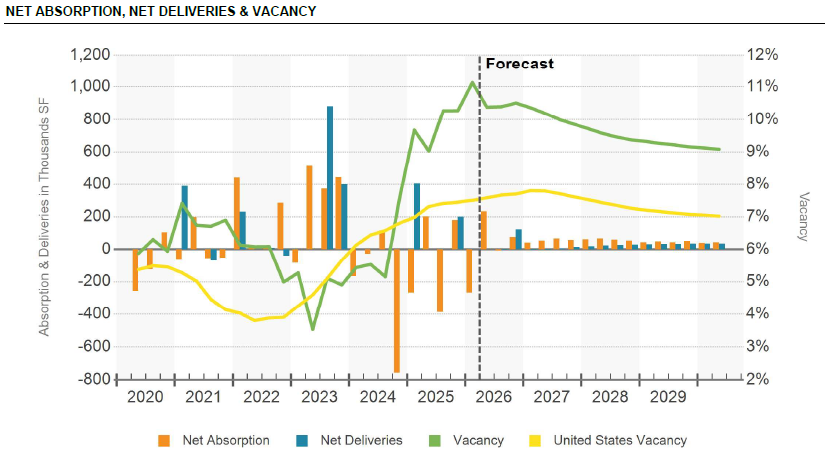
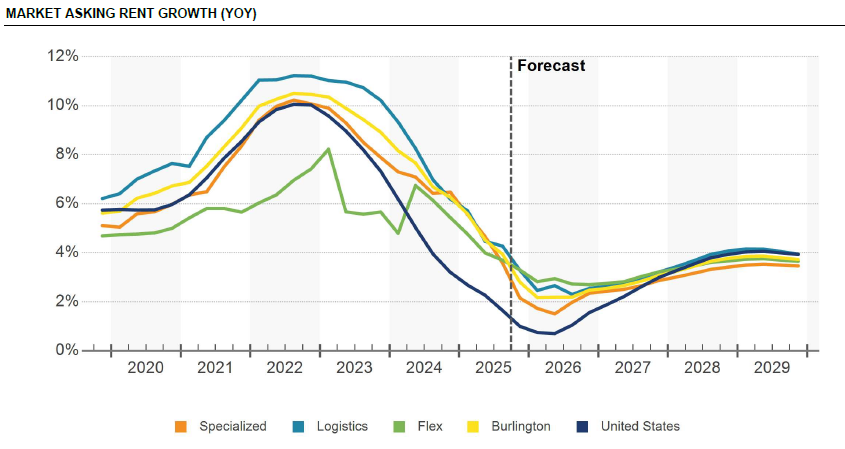
Key performance indicators for the quarter show a market that is currently digesting recent supply. The local vacancy rate rose to 11.1%, up from the previous quarter, while the broader availability rate sits at 11.7%. Despite the increase in vacancy, local asking rents have remained stable, showing modest positive growth of 3.0% year-over-year.
Key Market Indicators for Q1 2026:
Vacancy Rate: 11.1%
Market Total SF: 31.3M SF
Market Asking Rent: $6.31/SF
Asking Rent Growth: 3.0%
12 Mo Net Absorption: (275,089) SF
Under Construction: 127,500 SF
Source: CoStar Market Research
Source: CoStar Market Research
Market Value and Investment Trends
The total asset value of the Alamance County industrial market reached approximately $2.02 billion in the first quarter. Sales activity remained focused on value, with the market sale price per square foot averaging $64.
Investors are seeing a bifurcated pricing environment based on asset class:
Logistics Properties: Averaging approximately $69/SF.
Flex Assets: Commanding a premium at $91/SF.
Specialized Buildings: Trading at a more accessible $59/SF.
Transaction volume over the last 12 months totaled $29.3 million, with a market cap rate of 8.2%. This higher yield relative to the national average of 7.4% continues to make the region an attractive target for capital seeking better returns in a high-interest-rate environment.
National Context: The Broad View
Across the United States, the industrial sector is showing signs of having passed its cyclical vacancy peak. The national vacancy rate declined slightly to 7.0% in Q1, with net absorption reaching 40 million square feet—the strongest start to a year since 2023.
National asking rents continue to trend higher than local figures, averaging $10.20/SF. This spread highlights Alamance County’s continued position as a cost-effective alternative for logistics and manufacturing firms looking to optimize their supply chains away from higher-priced primary markets.
Economic Tailwinds and Regional Momentum
Macroeconomic conditions are shifting toward a more neutral stance. In March 2026, the Federal Open Market Committee (FOMC) voted to hold interest rates steady between 3.50% and 3.75%, signaling that the era of aggressive hikes has paused as inflation continues a sharper-than-expected cooling to 2.4%.
North Carolina's status as a powerhouse for economic development remains undisputed. In the first quarter of 2026 alone, the state announced over $3.66 billion in new capital investments and more than 3,300 new job commitments. Regional highlights include:
Guilford County: Ahold Delhaize announced an $860 million investment creating 505 jobs.
Wilson County: Johnson & Johnson committed $1 billion to a new project.
Wake County: Genentech announced a $650 million expansion.
These large-scale regional investments often generate secondary demand for industrial service providers and suppliers throughout the surrounding counties, including Alamance.
Looking Ahead
As we move further into 2026, the local construction pipeline remains remarkably lean at just 127,500 square feet, or only 0.4% of total inventory. This lack of new speculative supply is a critical "safety valve" for the market. With very little new competition entering the field, existing vacancy is expected to gradually compress as demand from regional economic growth absorbs the remaining available blocks. Property owners who maintain high-quality, efficient space—particularly in the logistics and flex segments—are well-positioned for stability in the coming quarters.
